
Most business owners hear “digital presence” and think, “We just need to be posting on Instagram and maybe Facebook.”
That’s a small part of it, but digital presence management is much bigger than dropping random posts on social media.
In this article, we’ll break down what digital presence management really means for SMEs and ecommerce brands, why your website should be the hub, and what needs to happen each month if you want your online presence to actually support your sales and reputation.
1. What is digital presence management?
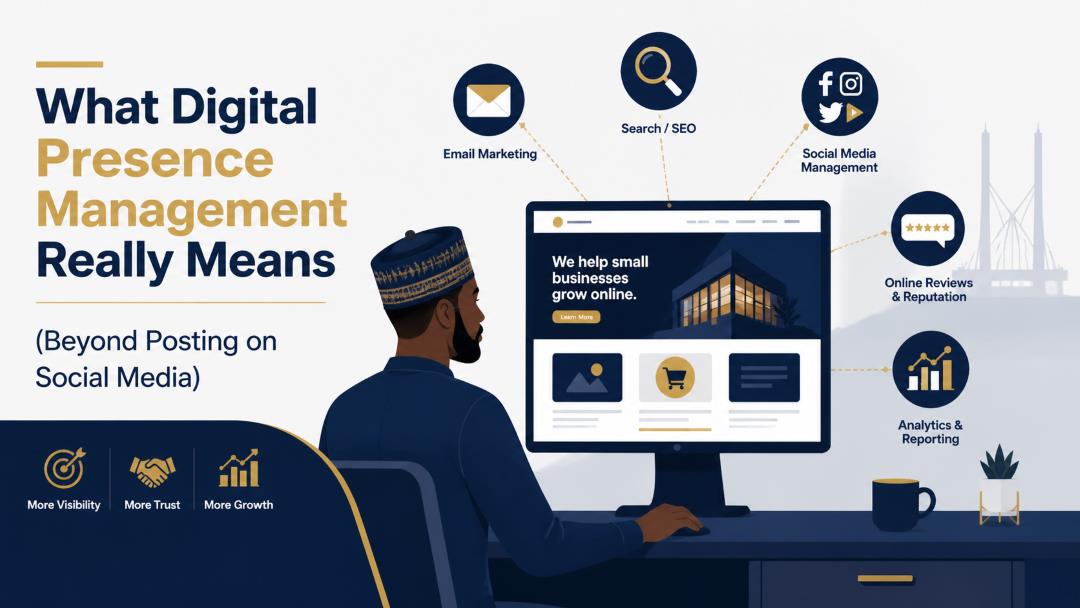
Your digital presence is every place your business shows up online and every way people experience you there.
Digital presence management is the ongoing work of building, monitoring and improving all those touchpoints so that:
People can find you
They can clearly understand what you do
They trust you enough to contact or buy
For a small business or ecommerce brand, this usually includes:
Your website (pages, blogs, landing pages)
Your social media profiles and content
Your search presence (Google results, local listings, basic SEO)
Your online reputation (testimonials, reviews, mentions)
Your email list or newsletter, if you have one
When you manage digital presence properly, all these pieces support each other instead of living in separate silos.
2. Why “posting on social media” is not enough
Posting on social media is useful, but by itself it has big limitations:
Algorithms can hide your posts from most of your followers.
People scroll quickly; they may like your post and forget your name two minutes later.
Social platforms change rules and priorities all the time.
If your whole digital strategy is “posting more”, you’re building on rented land.
You need a home base you control – your website – and then you use social media to drive people there.
Digital presence management asks different questions:
Where do your ideal customers first discover you?
When they search your name or services, what do they see?
If they click through, does your website help them take the next step?
Are you following up, educating and staying visible over time?
3. Your website as the hub of digital presence
Your website is the only major digital asset you truly own. It’s the hub that everything else should point back to.
A well‑managed website should:
Clearly explain who you help and what you do
Show proof (testimonials, case studies, logos, results)
Make it easy to contact you, book, or buy
Be fast, mobile‑friendly and kept up to date
In digital presence management, we’re not just designing a “nice looking” website once and leaving it to gather dust.
We’re managing it:
Updating pages as your offers change
Publishing fresh content (blogs, case studies, resources)
Improving SEO so more of the right people find you
Fixing issues before visitors even notice them
Think of your website as your best salesperson that works 24/7 – but only if you train and support it.
4. The main pillars of digital presence management
For SMEs and ecommerce brands, real digital presence management usually covers five pillars:
a) Website and content
Keeping your core pages updated (home, about, services/products, contact).
Publishing helpful blog posts or articles that answer your customers’ questions.
Creating landing pages for specific campaigns, offers or events.
This builds authority and gives your social media and email something meaningful to point to.
b) Search visibility and basic SEO
Using the right keywords on your pages and blog posts.
Adding internal links so people (and Google) can move easily through your site.
Making sure your site is indexable and technically sound.
You don’t have to become an SEO guru, but ignoring search completely means you miss out on people actively looking for what you do.
c) Social media with a purpose
Choosing a few platforms where your audience actually is.
Sharing content that points back to your website, your offers and your expertise.
Showing real work: behind‑the‑scenes, testimonials, quick tips, case snippets.
Social media becomes a distribution channel, not the main home.

d) Online reputation and trust
Collecting testimonials and reviews from happy customers.
Displaying them on your website and social channels.
Responding professionally to feedback and questions.
When people search your brand name, they should see more than just your homepage – they should see proof that others trust you.
e) Consistency and tracking
Having a simple content and update plan each month.
Tracking basic numbers: website visitors, enquiries, sales, key posts.
Adjusting based on what’s actually working.
Digital presence management is not a one‑time project; it’s steady, focused maintenance and improvement.
5. What this looks like each month in practice
To make this concrete, here’s how digital presence management might look in a normal month for a client:
Website updates
Add or refine one key page (e.g. service, product category, FAQ).
Publish 1–4 new blog posts or news stories depending on the business.
Upload new products or update existing ones (prices, images, descriptions).
Check for broken links or issues in the store flow.
Content and social
Turn blog posts into social media snippets and simple visuals.
Share them across selected platforms to drive people back to the site.
SEO and performance
Optimise titles, meta descriptions and headings for new content.
Review basic analytics: which pages people visit most, where they drop off.
Reputation
Add a new testimonial or case study highlight if available.
Encourage recent clients to leave a review or share results.
This kind of structured routine is what De‑Faith Concept does for ecommerce and media brands on retainer: we don’t just build the website once; we help run and evolve it with them.
6. How De‑Faith Concept approaches digital presence management
Different agencies define digital presence differently. At De‑Faith Concept, our focus is on SMEs, ecommerce and news/media sites, so we design our management around that.
Typically, for a client we:
Start with a website and digital presence audit
We review your site, content, search visibility, and social profiles.
We identify quick wins and deeper fixes.
Set clear monthly deliverables
Number of blog posts or news articles.
Number of social media creatives and posts.
Product uploads/updates if you run an ecommerce site.
Website tweaks and SEO improvements.
Create a simple calendar and reporting rhythm
Plan at the start of the month.
Execute and publish through the month.
Send a short report with what was done and key numbers at the end.
For some businesses, this is the difference between a quiet, forgotten website and a living online presence that continues to support sales, enquiries and brand awareness.
7. When you should consider getting help
You might be ready for true digital presence management if:
Your website is outdated but you don’t have time to fix it.
You’re posting on social media but it’s not translating into real enquiries or sales.
You keep meaning to “start blogging” or “update the site” but it never happens.
Every platform feels disconnected and you’re not sure what is working.
If that sounds like you, getting a partner to help manage your website and digital presence can free your time and give your marketing structure.
8. Next step: get a simple digital presence audit
If you’re not sure where to start, the easiest next step is a simple audit of your current digital presence.
We can:
Review your website, content, search results and key social profiles.
Highlight the biggest gaps and quick wins.
Suggest a monthly digital presence plan tailored to your type of business.
From there, you can decide whether to handle it in‑house or let us manage it with you on a retainer.
If you’d like that kind of clarity, you can Request an audit” and we’ll take a look at your current digital presence and share our recommendations.