

Many business owners already have a website, but it’s quietly sitting there like an online brochure.
They update it once in a long while and then wonder why it doesn’t show up on Google or bring in serious enquiries.
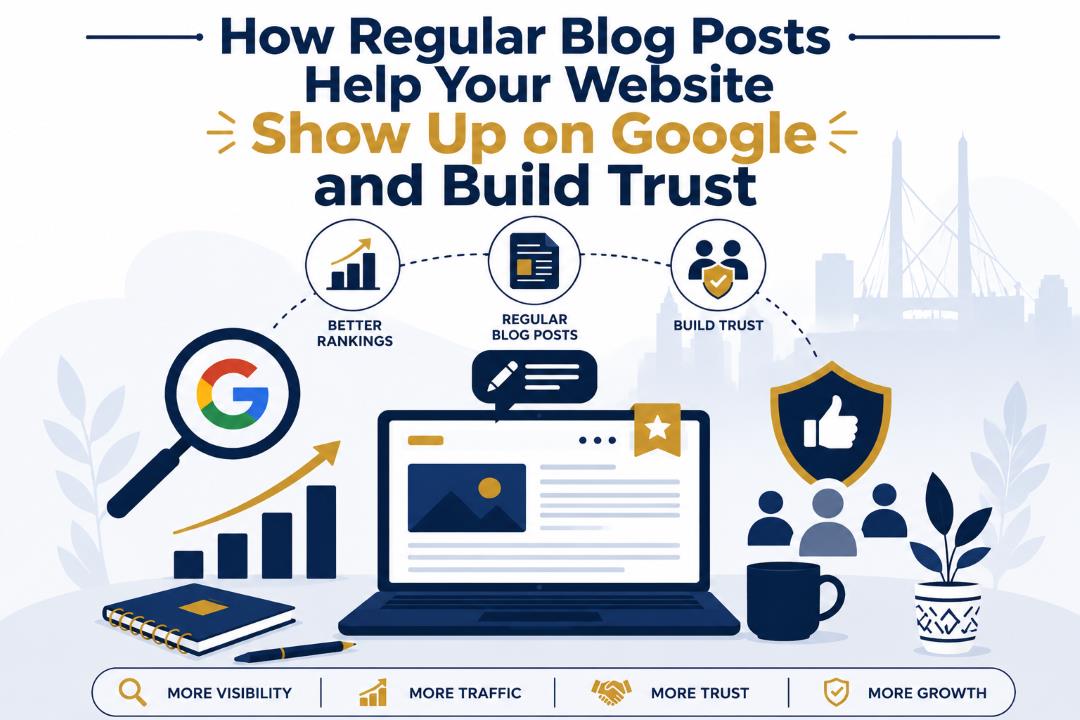
One of the simplest ways to change that is by publishing regular blog posts. When you treat your blog as a strategic tool instead of an afterthought, it can help your website rank better in search and position you as someone your audience can trust.
1. Why Google likes fresh, relevant content
Search engines are trying to show users the most helpful, up‑to‑date answers.
A website that is updated regularly with useful articles sends a strong signal:
“This business is active.”
“They are talking about this topic in depth.”
“They understand the questions people are asking.”
Every time you publish a new, relevant blog post, you:
Give Google another page to crawl and index.
Have another chance to show up for a specific question or keyword.
Expand the surface area of your website in search results.
Over time, a consistent schedule (even one good post a month) can help your site cover more search terms and appear for more queries than a static, rarely updated site.
2. Regular posts help you target more of the right keywords
Your main pages (Home, About, Services) can only target so many keywords without becoming messy.
Blog posts allow you to go deeper into specific questions your ideal clients have.
For example, instead of trying to rank a generic services page for broad terms like “website design” or “digital presence”, you can write focused posts like:
“How Regular Blog Posts Help Your Website Show Up on Google and Build Trust”
“What Digital Presence Management Really Means (Beyond Posting on Social Media)”
“From ‘Just a Website’ to Lead Machine: Simple Fixes SMEs Can Make”
Each of these posts can target a more specific phrase, attract a more qualified visitor and internally link back to your main service pages. Over time, this builds a strong network of related content that reinforces your authority around your topics.
3. Blog posts answer real questions from your ideal clients
Your blog should not be a place for random news your audience doesn’t care about.
The most effective posts are built around the real questions and doubts your ideal clients have, such as:
“Do I really need a website if I already have Instagram?”
“How do I know if my website is working?”
“What kind of content should be on my ecommerce product pages?”
“How can I keep my website and digital presence updated when I’m busy?”
When people find detailed, honest answers to questions they are already asking, they start seeing you as a guide, not just another service provider. That trust is a big part of why they choose you later.
4. Regular posts build authority and trust over time
Trust is not built in one visit.
When someone finds you on Google and sees that you have a library of helpful posts on topics they care about, they naturally think:
“These people know what they’re doing.”
“They’ve worked on this type of problem many times.”
“They’re serious enough to keep educating their audience.”
Publishing regular posts lets you:
Share case studies and stories (even if anonymised).
Demonstrate how you think and work.
Show your values and style before a client ever speaks to you.
For SMEs and ecommerce brands, this is powerful. Many of your competitors will never take the time to do it, which gives you a quiet but consistent advantage.
5. Blogging supports your other channels (not just SEO)
Regular blog posts don’t only help with Google.
They also give you better content for:
Social media – you can turn one blog into multiple captions, carousels, or short videos.
Email newsletters – instead of wondering what to send, you share your latest or best posts.
WhatsApp broadcasts or groups – you can drop a link with a short intro for your audience.
Instead of posting random tips with no structure, you have a content engine:
Write a useful blog → share it across channels → bring people back to your website.

6. How often should you publish blog posts?
You don’t have to publish every day to see benefits.
What matters more is consistency + quality.
For most small and medium businesses, a realistic starting point is:
At least 1 strong blog post per month
If possible, grow to 2–4 posts per month once you have a system
The key is to pick topics that are:
Closely related to your services or products
Based on real client questions and problems
Long enough to be helpful, but clear and easy to read
One well‑written, relevant post every month is far better than three random posts once a year.
7. Simple tips to make your blog posts SEO‑friendly
You don’t need to become an SEO expert, but you should do the basics:
Choose one main keyphrase per post and include it in:
The title
The URL slug
The first paragraph
At least one subheading
A few times naturally in the text
Write a short meta description (about 120–155 characters) that clearly says what the post is about and why it matters.
Use headings (H2, H3) and short paragraphs so people can skim.
Add internal links from the post to your relevant service pages and other related posts.
Use at least one relevant image with descriptive alt text.
Doing these simple things repeatedly is enough to make a difference for many SMEs.
8. How De‑Faith Concept helps clients with blogging and digital presence
For many business owners, the challenge is not understanding the benefits; it’s finding the time and system to do it consistently.
As part of our digital presence management retainers at De‑Faith Concept, we typically:
Plan a content calendar based on your business goals and customer questions.
Write and optimise regular blog posts for your website.
Upload and format posts properly (headings, images, internal links, SEO fields).
Turn those posts into social media content that brings people back to your site.
Track simple numbers so you know which topics and posts are working best.
The result is a website that grows richer and more trusted every month, instead of getting older and more outdated.
9. A simple next step
If your website has been quiet and you’d like it to start working harder for your business, a good first step is to review:
What questions your ideal clients keep asking you
Which of those are missing from your website and blog
From there, you can decide whether to handle the writing in‑house or work with a partner.
If you’d like help, you can Request an Audit and we’ll take a look at your website and current content, then suggest a simple blogging and digital presence plan tailored to your business.