
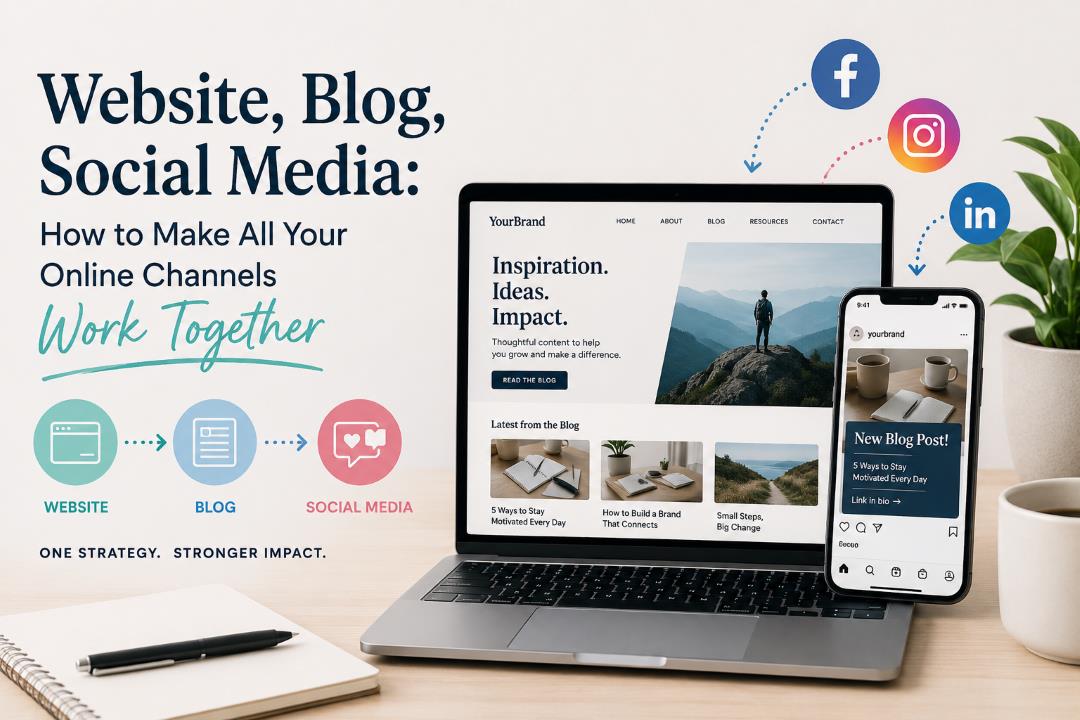
Most businesses have a website, maybe a blog and one or two social media pages, but they all feel disconnected.
The website says one thing, Instagram says another, and the blog is either empty or filled with random topics.
When your website, blog and social media work together, every post supports the same message and gently leads people towards your offers.
In this guide, I’ll show you how to align your channels so they stop working in silos and start working as one system.
Why your online channels feel disconnected
Many small businesses create channels one by one: first a website, then social media, then a blog.
Because there’s no central plan, each channel develops its own “personality” and content style.
Common signs everything is out of sync:
Different brand voice and visuals across platforms
Social posts that don’t link back to your website
A blog that doesn’t answer the questions you get on social media
Confusing offers and calls‑to‑action across channels
The result is simple: people see you online but don’t know what to do next.
Our goal is to change that by giving each channel a clear role in one unified digital presence.
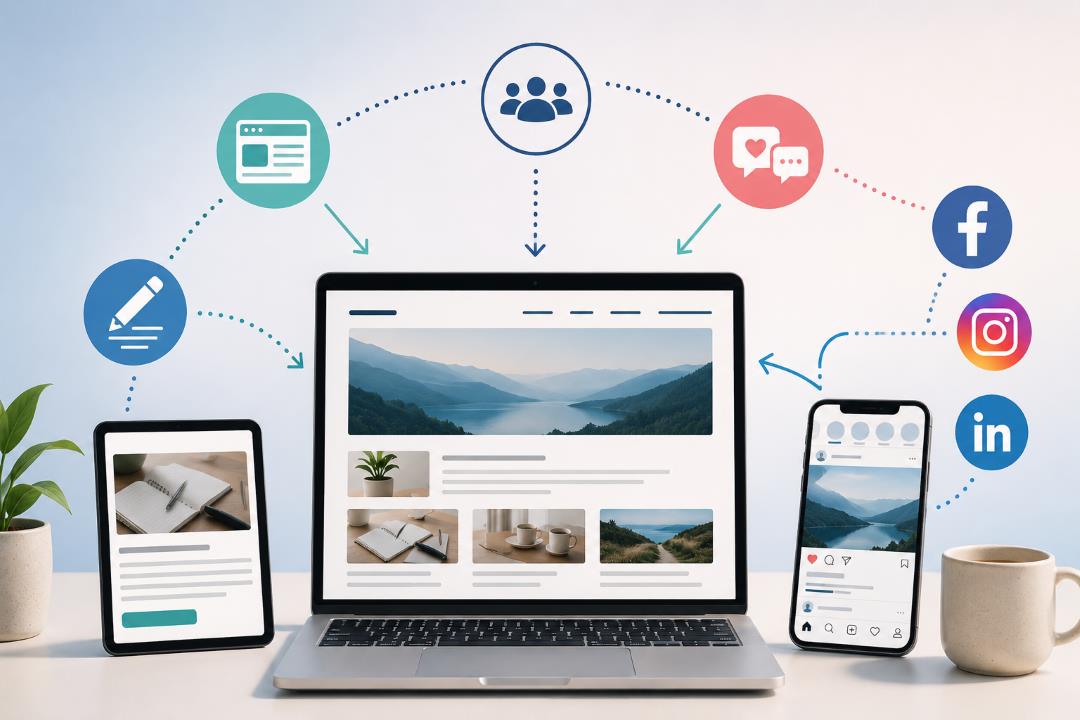
Decide the role of each channel
Before you think of tools, think of roles.
Each channel should have a specific job in your marketing system.
Your website – your digital headquarters
Your website is your home base.
It should clearly show who you are, what you offer and how people can take the next step.
Key roles:
Host your main pages (Home, About, Services, Contact, Shop)
House your long‑form content (blog or resources)
Handle conversions (enquiries, bookings, sales, email signups)
If social media disappeared tomorrow, your website should still stand as your central digital asset.
Your blog – your teaching and trust engine
Your blog is where you educate and build trust.
Here you answer real questions, address objections and show your process.
Key roles:
Attract visitors from Google and other search engines
Provide helpful content you can keep sharing from social media and email
Warm up visitors before they contact you or buy
Every strong blog post should connect back to a clear offer or next step on your website.
Social media – your distribution and relationship channel
Social media is your amplifier and relationship builder.
Most people will meet you first on Instagram, Facebook or LinkedIn before they ever see your website.
Key roles:
Distribute your content (blog posts, offers, testimonials)
Start conversations and build relationships
Drive the right people back to your website and offers
The more you see social media as a bridge to your site, not a replacement for it, the more effective it becomes.
Start with one core content plan
To make all your channels work together, you need one simple content plan at the centre.
Think of this like a monthly “theme” or content pillar.
Steps:
Choose 1–2 core topics each month that matter to your ideal clients.
Create at least one strong blog post around each topic.
Plan social media posts that point back to those blog posts and related pages on your website.
Example:
If your focus this month is “improving online sales”, your content system might look like:
Blog post: “5 Reasons Your Website Visitors Are Not Buying (And How to Fix It)”
Website page focus: refine your Services or Shop page to match this topic
Social posts: short tips, before/after examples, carousels and reels all linking back to that blog post or sales page
Now your website, blog and social media are saying the same thing in different formats.
Connect your website and blog properly
Your blog lives on your website, but you need to link them together intentionally.
Practical steps:
Make sure your blog is easy to find from your main menu and homepage
From each blog post, link to:
A related service page
A relevant product (if you run ecommerce)
A simple call‑to‑action such as “Book a consultation” or “Request a quote”
On your service or product pages, link back to blog posts that explain or support that service
This two‑way internal linking helps visitors go deeper and also gives search engines a clear picture of what each page is about.
Turn each blog post into social media content
Instead of struggling for daily ideas, let your blog do the heavy lifting.
One good blog post can give you multiple social media pieces.
From one article, you can create:
2–4 short tips or quote graphics
1–2 carousels that break down the main steps
A short video or reel summarising the key idea
A poll or question to collect feedback from your audience
Each of these should include a light call‑to‑action, such as:
“Read the full breakdown on the blog”
“See the full checklist on my website”
“Learn more about this service on our site”
This way, your social media feeds your website, and your website content feeds your social media.
Create simple journeys for your audience
When your channels work together, people don’t just see random posts—they follow a simple journey.
Example journey:
Someone discovers you through an Instagram reel.
They tap through to read the full blog post on your website.
On the blog, they see a clear call‑to‑action to join your email list or view your service.
They sign up, then receive a helpful email sequence that invites them to book a call or shop.
Ask yourself for every piece of content:
“What is the next step I want this person to take?”
Then, make sure your website, blog and social media are clearly pointing in that direction.
Keep your branding and messaging consistent
Even if your content is strong, inconsistent branding can confuse people.
Make it easy for them to recognise you across all online touchpoints.
Checklist:
Use the same or very similar profile photos and logos everywhere
Stick to a consistent colour palette and typography style
Repeat your core brand message and tagline across your website, blog and social media bios
Keep your tone of voice steady: professional and friendly, simple and clear
Consistency builds trust.
When people recognise you quickly, they also remember you when they are ready to buy.
Measure and adjust your online ecosystem
Finally, to keep all your channels working together, you need to measure what’s happening.
Track simple metrics:
On your website:
Which blog posts bring the most visitors?
Which pages people visit before they contact you or buy?
On your social media:
Which posts drive the most link clicks to your website?
Which topics get the most saves, shares or comments?
Use these insights to decide:
What to write about next on your blog
Which services or products to highlight on your website
Which types of social posts to create more often
Over time, this feedback loop builds an online presence that feels connected, clear and profitable.
Bringing it all together
You don’t need to be everywhere to have a strong digital presence.
You simply need your website, blog and social media to point in the same direction.
Start small:
Clarify the role of each channel
Plan one core topic at a time
Link your content so people always know the next step
As you repeat this process month after month, your channels stop working separately and start working together to attract, educate and convert the right people for your business.
If you’d like help, you can Request an audit, and we’ll take a look at your website and book a consultation to align your channels.