

Most schools, clinics and training centres already have websites, but many of those sites are quiet. They look fine on the surface, yet they rarely bring in serious enquiries, WhatsApp messages or phone calls. Instead of working as a 24/7 front‑desk that informs and converts visitors, the website ends up as a digital brochure that people quickly skim and close. The good news is that with a few intentional changes, your website can start attracting more of the right enquiries every month.
In this article, I’ll walk through practical ways schools, clinics and training centres can use their websites to get more enquiries – without needing a complete rebuild from scratch.
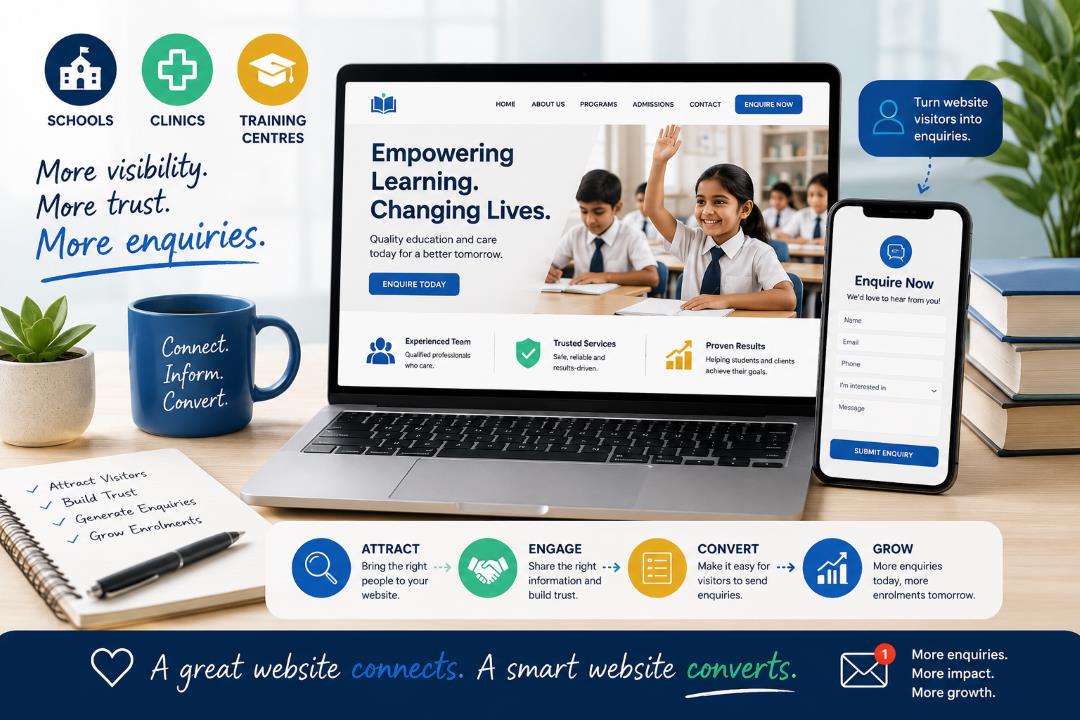
1. Make “who you are” and “what you do” instantly clear
When a parent, patient or potential trainee lands on your website, they should know in seconds whether they are in the right place.
If they have to read long paragraphs to figure out what you offer, they will simply leave.
You want your homepage hero section to answer three simple questions fast:
Who are you?
Who do you serve?
What do you offer?
Examples:
“Montessori primary and secondary school in Ikeja, Lagos”
“Women’s health and fertility clinic in Lekki”
“Health and safety training centre for corporate teams in Abuja”
Place this clearly in your main heading and supporting text.
Avoid vague lines like “Excellence in education” or “Committed to your health” without context.
Clarity builds trust and makes visitors more likely to read further and enquire.
2. Use clear calls‑to‑action that invite enquiries
Many institutions explain what they do but never clearly tell visitors what to do next.
If you want more enquiries, you must guide people to take the next step.
Think about the most important actions you want people to take on your website:
For schools: “Book a school tour”, “Request admission information”, “Start application”
For clinics: “Book an appointment”, “Request a callback”, “Send us a WhatsApp message”
For training centres: “Download course brochure”, “Enquire about dates and fees”, “Register interest”
Turn these into strong calls‑to‑action (CTAs) and place them:
In the top navigation (e.g. a button that stands out)
In the hero section on your homepage
At the end of key sections and pages
On your contact and services pages
Keep your enquiry forms short and focused.
Ask only for the information you truly need to follow up: name, contact details, and a few relevant questions.
The easier it is to enquire, the more people will actually do it.
3. Talk about benefits, not just features
Most websites list features: number of classrooms, equipment, services or courses.
While these matter, visitors are mainly interested in the benefits and outcomes.
Consider:
Parents don’t just want to see that your school has a lab; they want to know that their children will learn practical science skills and pass important exams.
Patients don’t just want a list of services; they want faster relief, trusted care and clear guidance.
Trainees don’t just want course titles; they want skills that lead to better jobs, promotions or business opportunities.
Rewrite parts of your website to highlight benefits such as:
“Small class sizes so your child gets more individual attention.”
“Experienced consultants who explain your condition in clear language.”
“Hands‑on training with real‑world projects you can add to your CV.”
Use short paragraphs and bullet points.
Make it easy for visitors to see “what’s in it for me?” at a glance.
When people see themselves in your copy, they feel more confident about making an enquiry.
4. Make it very easy to contact you
Some websites accidentally hide their contact details.
Phone numbers are buried, WhatsApp buttons are missing, and contact forms are hard to find.
This creates friction and kills potential enquiries.
To fix this, make sure your website:
Shows your phone number and WhatsApp link clearly on every page (header or footer).
Has a simple, well‑designed contact page with all options: phone, WhatsApp, email, address and opening hours.
Includes click‑to‑call and click‑to‑WhatsApp buttons that work well on mobile.
Displays your physical location with a map (especially for schools and clinics).
Think about the channels your audience actually uses.
In Nigeria and many other places, WhatsApp is often the first contact method.
Making that option prominent can significantly increase enquiries.
5. Build trust with proof and clear information
Before someone entrusts you with their child, health or professional development, they need to trust you.
Your website should reduce fear and uncertainty by providing evidence and clear information.
Ways to build trust:
Testimonials and reviews
Short quotes from parents, patients or trainees sharing their positive experiences.
Where appropriate, use initials, roles or first names and locations.
Success stories and case studies
For schools: achievements of students, exam results, university placements.
For clinics: anonymised success stories, improved outcomes, patient satisfaction.
For training centres: people who got jobs, promotions or contracts after training.
Credentials and affiliations
Show relevant accreditations, associations, regulatory approvals and partner logos.
Explain these briefly in plain language so visitors understand why they matter.
Useful FAQs
Answer common questions about fees, payment plans, safety, policies, insurance, schedules, requirements and more.
An honest and thorough FAQ section can remove doubts and move people closer to an enquiry.
When visitors can see real stories, clear credentials and straightforward answers, they feel safer taking the next step.
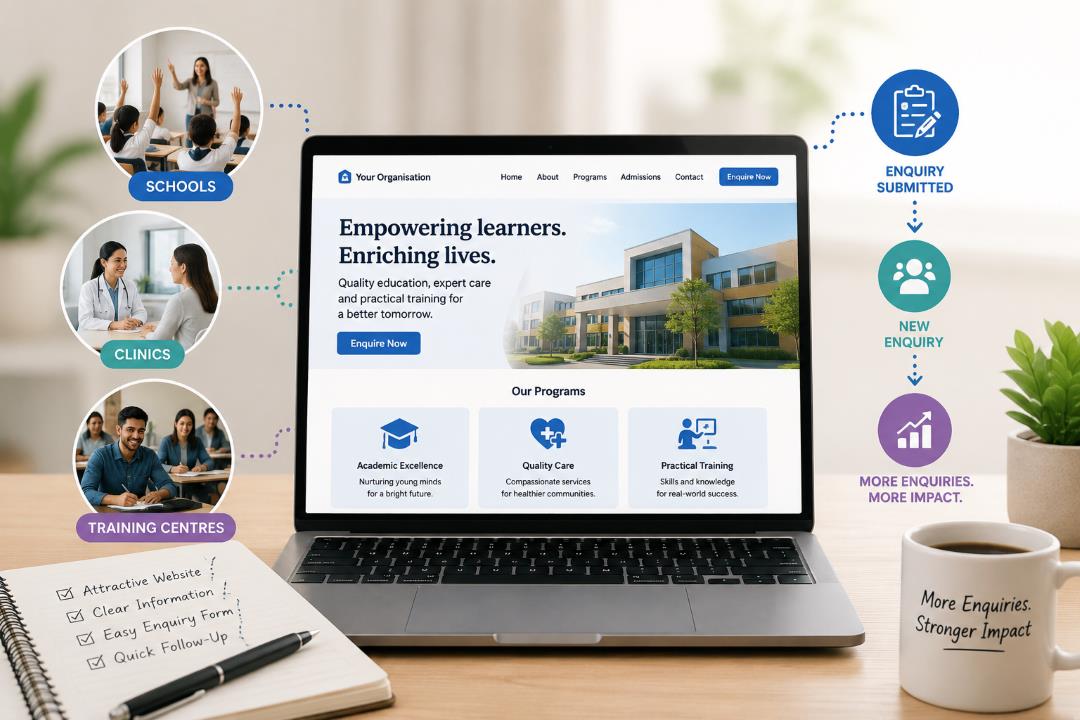
6. Use educational content to answer real questions
Blog posts or resource pages are powerful tools for attracting and converting enquiries.
Instead of only talking about yourself, use your content to help your audience solve real problems and make better decisions.
Examples of helpful content:
For schools
How to choose the right school for your child in [City].
What parents should look for in a Montessori or British curriculum.
How to prepare your child for entrance exams.
For clinics
Common myths about a specific condition and the facts.
What to expect during a first visit for a particular treatment.
Simple health tips for your target audience.
In‑demand skills employers are looking for in [year].
How to choose the right training course for your career goals.
Differences between similar courses and who they are best for.
Each piece of content should end with a relevant CTA, such as:
“Want to know if our school is a good fit for your child? Book a school tour.”
“Ready to discuss your symptoms with a professional? Request an appointment.”
“Interested in this course? Send us a message to get the next start date and fees.”
This way, your content not only educates but also gently leads readers to enquire.
7. Optimise your website for local search
Most schools, clinics and training centres serve people in specific areas.
Local search optimisation helps people near you find your website when they search on Google.
Simple local SEO steps include:
Use your location in key places
Add your city or area to important headings and paragraphs (e.g. “Primary school in Ikeja, Lagos” or “Dental clinic in Abuja”).
Include location phrases naturally, not by stuffing keywords.
Keep your contact details consistent
Make sure your name, address and phone number (NAP) are consistent on your website, Google Business Profile and directories.
Encourage reviews
Ask happy parents, patients and trainees to leave reviews on Google and other relevant platforms.
Respond politely to reviews to show that you care about feedback.
Create location‑focused pages where useful
If you serve multiple locations, consider a page for each key area.
On those pages, describe the services you provide there and how people can contact you.
Local visibility increases the number of people who discover you, and a well‑structured website converts more of that traffic into enquiries.
8. Track enquiries and improve over time
To truly use your website as an enquiry engine, you need to know what is working and what is not.
Tracking and simple analysis will help you make better decisions.
You can:
Track how many enquiries come from forms, calls and WhatsApp each month.
Ask new contacts how they heard about you (website, Google, social media, referral, etc.).
Monitor which pages get the most visits and lead to the most enquiries.
Test different CTAs, headlines and images over time.
Even small improvements – such as shortening a form, simplifying a headline or making a button more visible – can increase your enquiry rate.
The goal is to treat your website as a living, improving asset, not a one‑time project.
Final thoughts: Turn your website into a working asset
For schools, clinics and training centres, a website is no longer optional – but simply having one is not enough.
To get more enquiries, your site needs to be clear, helpful, trustworthy and easy to act on.
By:
Clearly explaining who you are and who you serve
Using strong calls‑to‑action
Highlighting benefits and outcomes
Making contact effortless
Building trust with proof and FAQs
Publishing helpful, educational content
And optimising for local search
…you give your website a real job: bringing in serious, relevant enquiries.
If you run a school, clinic or training centre and you suspect your website is underperforming, De‑faith Concept Agency can help you turn it into a proper enquiry‑generating asset.
Reach out to discuss your current site and the practical changes that can make a difference.