
What does a professional website cost in Nigeria?
Recent Nigerian guides put the average cost of a professional small to mid‑sized business website in the ₦150,000–₦700,000 range, depending on features and complexity. Below ₦100,000 you are usually getting a very basic, mostly template‑based site with limited support, while advanced custom builds or web applications can easily go into the millions.
Typical price bands you can reference in your article:
Basic one‑page / landing page: about ₦80,000–₦210,000.
Simple 3–5 page brochure site: about ₦150,000–₦300,000.
Small business / 10–20 page corporate site: about ₦200,000–₦500,000.
E‑commerce site: commonly ₦250,000–₦1,000,000+ depending on products and integrations.
Custom web apps / complex platforms: from about ₦500,000 up to ₦5,000,000+ for specialised builds.
This gives context so SMEs see where their needs fit on the spectrum, instead of chasing random figures.
5 core things SMEs are really paying for
1. Strategy and planning
Serious projects start with understanding your goals, target audience and how the website will generate leads or sales. When your budget is too low, agencies skip this step and simply “spin up” a template, which rarely performs well.
What should be in scope:
Clarifying business goals (leads, bookings, sales, visibility).
Mapping key pages and user journeys for your ideal customers.
Choosing the right platform (e.g. WordPress vs full custom build) for your stage and budget.
Position this in your post as the difference between “just a website” and a revenue‑focused digital asset.
2. Design, UX and content
Professional design is not just about colours; it is about guiding visitors smoothly to take action on every device. Nigerian SMEs often underestimate the time it takes to craft layouts, copy and visuals that build trust and convert.
Budget typically covers:
Custom layouts, branding alignment and responsive design.
Copywriting or copy editing for key pages, not just “lorem ipsum”.
Basic on‑page SEO structure (headings, metadata, internal links).
The more customised and conversion‑focused the design and content, the higher the investment tends to be.
3. Development, integrations and features
The cost also reflects how many features and integrations your website needs, plus who is building them. E‑commerce, bookings, custom forms, membership areas and APIs all add development time.
Examples that move you up the pricing ladder:
Simple brochure site vs full e‑commerce with payment gateway and inventory.
Basic contact form vs advanced quoting, booking or CRM integrations.
Off‑the‑shelf theme vs heavily customised or fully custom build.
You can mention that experienced agencies charge more because they build cleaner, more secure and scalable systems.
4. Infrastructure: domain, hosting and security
Many “cheap” quotes exclude or underprice essentials like premium hosting, SSL certificates and backups, which are critical for a serious SME website. Reliable infrastructure affects speed, uptime, security and your professional image.
Key recurring items:
Domain name (usually yearly).
Hosting with enough resources and security for business use, not just the cheapest shared plan.
SSL certificate, updates and basic security hardening to protect data and reputation.
Clarify in your article that a realistic budget includes both build cost and annual running costs.
5. Ongoing support, updates and marketing
A website is not “done” on launch day; it needs updates, content, performance improvements and marketing to bring traffic and conversions. Many SMEs under‑budget for ongoing support and then wonder why their site becomes slow, hacked or invisible in search after a year.
Ongoing services that are often extra:
Monthly maintenance (updates, backups, bug fixes).
Content and SEO retainers to keep rankings and traffic growing.
Conversion optimisation and analytics reviews to keep improving results.
Encourage SMEs to treat this as part of their marketing budget, not just a “tech cost”.
How much should a Nigerian SME really budget?
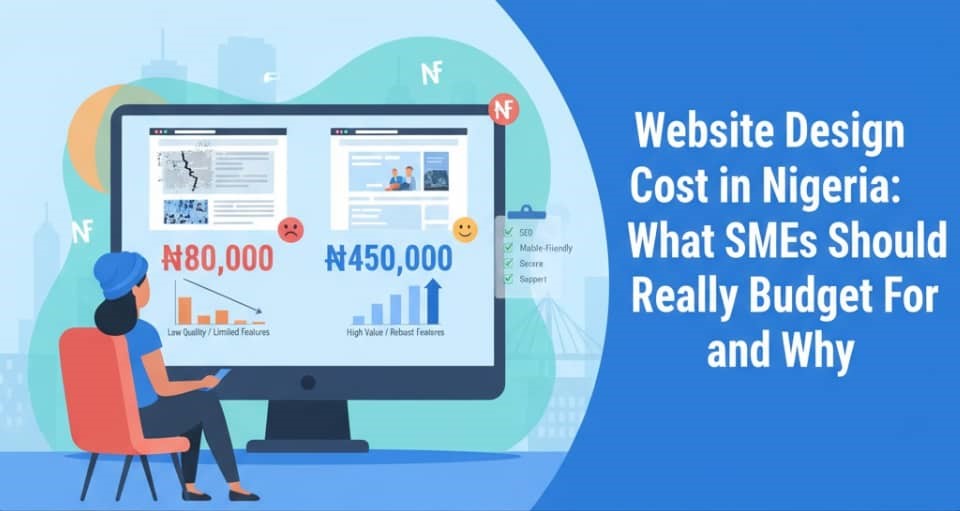
Using current 2025–2026 ranges, a serious SME that wants a professional, conversion‑focused website should usually budget at least ₦250,000–₦600,000 for design and development alone. For more complex e‑commerce or custom functionality, planning around ₦450,000–₦1,000,000+ is common.
You can summarise realistic SME budgets like this:
Lean starter presence: ₦150,000–₦250,000 (template‑leaning, minimal features).
Growth‑focused SME website: ₦250,000–₦600,000 (customised design, better UX, basic SEO, lead capture).
Aggressive growth / e‑commerce or advanced features: ₦450,000–₦1,000,000+ (more integrations, CRO and marketing alignment).