
Ad costs keep rising, tracking gets harder, and many Nigerian brands are seeing flat or falling results even when they keep increasing their ad budgets. If your online store already gets some traffic but orders are not where you want them to be, the problem is often inside the website and funnel, not in your ad account.
The good news: you can usually increase online orders by improving how you use the traffic you already have—fixing your product pages, checkout experience, offers, and follow‑up—before you spend more on ads.
Step 1: Make sure visitors instantly understand your offer
If new visitors don’t quickly understand what you sell, why it’s for them, and why they should trust you, they won’t buy—no matter how good your ads are.
Check your homepage and key landing pages:
Does the top section clearly state what you sell and who it’s for (e.g. “Affordable Nigerian fashion for women size 8–24, delivered nationwide”) instead of vague slogans?
Are your main product categories or bestsellers visible without too much scrolling?
Is there one clear primary action: “Shop Now”, “View Collection”, “Order on WhatsApp”?
Small changes to copy and layout at the top of the page can significantly increase add‑to‑cart and click‑through to product pages.
Step 2: Improve product pages so they do the selling for you
Many Nigerian stores rely on ads to do all the persuasion, while product pages are weak: short descriptions, poor photos, no benefits or proof. Better product pages turn more visitors into buyers without extra ad spend.
Strengthen your product pages:
Photos:
Use clear, high‑quality images (front, back, close‑ups, lifestyle if possible).
Allow zoom or multiple angles where your platform supports it.
Descriptions:
Go beyond basic specs—explain benefits and use cases (“perfect for hot Lagos weather”, “ideal for busy professionals”).
Answer common questions (size/fit, materials, usage, care, etc.).
Price and CTA:
Make price and “Add to Cart” or “Order on WhatsApp” very clear and visible.
Avoid hiding CTAs below the fold or in low‑contrast buttons.
Social proof:
Add reviews or at least short testimonials, especially for popular products.
Show “bestseller” or “popular choice” labels where appropriate.
Better product pages increase conversion from existing traffic, which means more orders from the same number of visitors.
Step 3: Reduce friction in the checkout and order process
Many Nigerian shoppers abandon their carts because checkout feels stressful, confusing, or untrustworthy. Fixing friction at this stage is one of the fastest ways to get more orders without new ads.
Look at your checkout flow:
Number of steps:
Minimise the number of pages/fields. Enable guest checkout if possible.
Payment and delivery clarity:
Clearly show accepted payment methods (cards, transfers, pay‑on‑delivery if you offer it).
State delivery locations, fees, and timelines before the last step.
Form design:
Use clear labels and error messages.
Make sure forms are easy to fill on mobile phones.
Trust signals:
Show security icons, simple guarantees (“7‑day returns”, “secure checkout”), and contact/WhatsApp support near the checkout area.
Even a small percentage drop in abandonment at checkout can mean dozens or hundreds of extra orders per month from the same ad budget.
Step 4: Fix speed and mobile experience
Nigeria is mobile‑first. Slow or badly optimised sites lose visitors before they ever see your offer.
Test and improve:
Use tools like PageSpeed Insights or similar to test your home, category, and checkout pages on mobile.
Compress and resize large images, especially banners and product photos.
Remove unused or heavy scripts/plugins that slow down the site.
Make sure menus, buttons and forms are easy to use on smaller screens.
Faster, smoother mobile experiences consistently lead to higher conversion rates, especially for ecommerce.
Step 5: Use email and WhatsApp to recover lost sales
Most visitors don’t buy on their first visit. If you rely only on ads to bring them back, you’re paying multiple times for the same people. Instead, build owned channels (email and WhatsApp lists) so you can follow up for free or at low cost.
Practical ideas:
Add a simple email/WhatsApp capture with a compelling reason:
“Get ₦X off your first order”
“Get size/fit guide + early access to new drops”
Send follow‑up messages about:
Abandoned carts or browsed items (where tools allow).
Back‑in‑stock alerts.
New collections and limited promos focused on real value, not constant discounts.
One well‑structured follow‑up flow can bring a steady stream of additional orders without increasing ad spend.
Step 6: Improve your offers instead of just pushing more traffic
Sometimes the issue isn’t traffic but how attractive your offers are when people reach the site.
Consider:
Bundles (e.g. “3 for” deals, outfit sets, starter packs).
Free shipping thresholds (“Free delivery when you spend ₦X+”).
Small bonuses (free samples, small gifts for orders over a certain amount).
Clear guarantees and return policies.
Improved offers plus better UX often increase conversion more than simply running more ads with the same weak proposition.
Step 7: Track the right numbers and test small changes
To grow orders without increasing ad spend, you need to measure conversion and run simple experiments.
Track at minimum:
Website sessions (visits).
Add‑to‑cart rate.
Checkout initiation rate.
Completed orders.
Overall conversion rate (orders ÷ visits).
Then test small changes, such as:
New hero copy on the homepage.
Different main CTA (“Shop Now” vs “Order on WhatsApp”).
Reordered sections on the product page.
Different free shipping threshold.
Change one major thing at a time and compare results over a few weeks.
Putting it all together: a simple 30‑day plan
Instead of “more ads”, try this:
Week 1: Fix clarity on home and category pages, and strengthen product pages.
Week 2: Simplify checkout and improve trust signals; check mobile UX.
Week 3: Optimise speed and set up at least one email or WhatsApp follow‑up.
Week 4: Review numbers, identify the biggest drop‑off, and run one simple test there.
This approach is in line with modern conversion‑rate optimisation best practices and typically yields better ROI than just increasing ad budgets.
How I help Nigerian brands increase orders without more ads
My focus with Nigerian brands is not just building ecommerce sites, but making them convert:
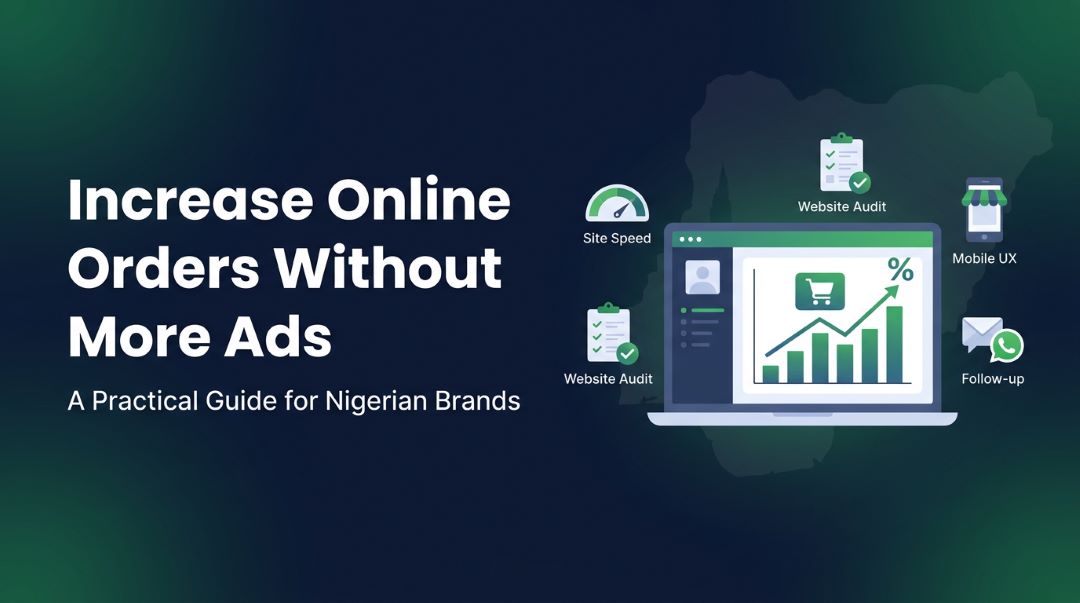
Running an ecommerce website audit to find UX, speed and funnel issues.
Fixing product pages, checkout flows and mobile experience.
Setting up basic tracking, email/WhatsApp follow‑ups, and simple tests.
Providing ongoing maintenance and optimisation so your store keeps improving.
If your ads are bringing traffic but your orders are not where they should be, it’s time to look inside your website and funnel, not just at “more reach”.
Ready to get more orders from the traffic you already have?
Request an Ecommerce Website Audit & Conversion Review and I’ll show you the exact changes that can increase your online sales without raising your ad budget.