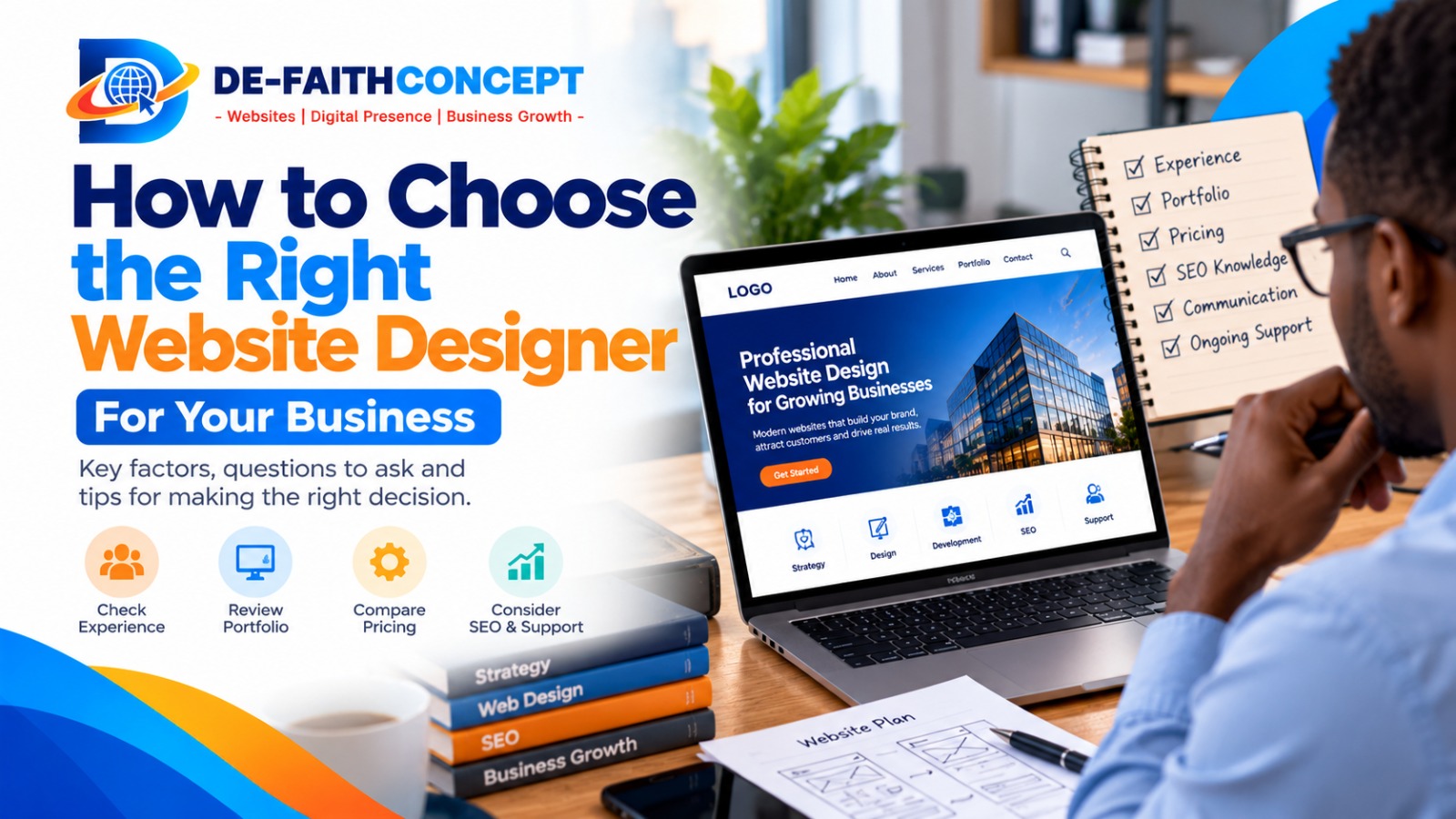
Choosing the right website designer is an important decision for any business that wants to build a strong online presence. Your website can help potential customers discover your services, understand what you offer, build trust in your brand and contact you when they are ready to buy.
However, finding the right designer can be challenging. Some developers focus mainly on appearance, while others consider usability, search engine optimisation, performance and the business goals your website needs to support.
So, how do you choose a website designer who understands your business and can deliver a website that meets your needs?
In this guide, we explain the key factors to consider before hiring a website designer, the questions to ask, warning signs to watch for and how to make a confident decision.
1. Understand Your Business Goals Before Hiring a Designer
Before searching for a website designer, decide what you want your website to achieve.
A website designed to generate service enquiries will have different requirements from an online store or an educational platform.
Ask yourself:
- Do I need a website for my new business?
- Do I want to generate more enquiries or sales?
- Do I need customers to book appointments online?
- Do I want to sell products through an ecommerce store?
- Do I need to redesign an existing website?
- Do I need a custom web application or customer portal?
Write down your main objectives and the features you need. This will help you explain your expectations to potential designers and compare their proposals more accurately.
You do not need to know every technical detail. A good website designer should help you translate your business goals into a practical website plan.
2. Review the Designer’s Portfolio and Previous Projects
One of the best ways to evaluate a website designer is to examine their previous work.
A portfolio helps you understand the designer’s capabilities, visual style and experience with different types of websites.
When reviewing a portfolio, consider the following:
Relevance: Has the designer worked on projects similar to yours? Experience in your industry can be helpful, although it is not always essential.
Design quality: Do the websites look professional, organised and consistent with the businesses they represent?
Usability: Is the navigation clear? Can visitors find important information easily?
Mobile responsiveness: Open the websites on your phone to see whether the content and navigation work properly.
Functionality: Test important features such as contact forms, product pages, booking systems and navigation links.
Do not judge a designer solely by screenshots. Visit the actual websites whenever possible and explore how they work.
You can view examples of work on the De-Faith Concept projects page.
3. Look Beyond Visual Design
A beautiful website is useful, but appearance alone does not determine whether it serves your business effectively.
A good website should also be easy to navigate, communicate your value clearly and guide visitors towards relevant actions.
For example, a service business may need prominent contact details, clear descriptions of its services, customer testimonials and visible enquiry buttons.
An online store may require organised product categories, useful product descriptions, a straightforward checkout process and reliable payment integration.
Ask a prospective designer how they will approach:
- Website structure and navigation.
- User experience and mobile usability.
- Calls to action and enquiry forms.
- Page loading performance.
- Search engine optimisation.
- Security and ongoing maintenance.
The objective is to create a website that supports your business, not simply one that looks impressive in a presentation.
4. Check Their SEO Knowledge
Search engine optimisation should be considered during website planning, rather than treated as an afterthought.
A designer does not necessarily need to be a specialist SEO consultant. However, they should understand the technical and on-page foundations that help search engines discover and interpret website content.
These include:
- Descriptive page titles and meta descriptions.
- Clear heading structures.
- Search-friendly URL structures.
- Mobile-responsive layouts.
- Appropriate image optimisation and alternative text.
- Internal linking.
- XML sitemaps and indexability basics.
- Secure connections and reasonable page performance.
Ask whether basic SEO setup is included in the quotation and which tasks are covered.
Keep in mind that a search-friendly website does not automatically rank at the top of Google. Content quality, competition, relevance and ongoing optimisation also matter.
For additional guidance, consult Google’s SEO Starter Guide.
5. Confirm That They Understand Mobile-Friendly Design
Many customers discover businesses and browse services on their smartphones. Your website should therefore provide a good experience across different screen sizes.
During your evaluation, check whether the designer:
- Creates layouts that adapt to mobile screens.
- Uses readable text and appropriately sized buttons.
- Keeps navigation easy to use.
- Ensures forms are convenient to complete.
- Optimises images and other page resources.
- Tests the website across relevant browsers and devices.
A website that works well on a desktop but is difficult to use on a phone may frustrate potential customers.
Ask the designer how mobile testing is included in their development process.
6. Compare Pricing, Deliverables and Value
Website design prices vary according to the scope of the project, the designer’s experience, the features required and the level of customisation involved.
When comparing quotations, avoid choosing solely on the lowest price.
Instead, determine exactly what each proposal includes.
What to compare | Questions to ask |
Website pages | How many pages are included? |
Design | Is the design customised or template-based? |
Content | Who writes and uploads the content? |
SEO | What SEO setup is included? |
Functionality | Are forms, payment gateways or booking tools included? |
Hosting and domain | Are these included, and for how long? |
Revisions | How many revision rounds are allowed? |
Maintenance | Is post-launch support included? |
A lower quotation may be suitable for a simple website, while a more complex project may justify a larger investment.
The important thing is to understand what you are paying for and whether the proposed solution fits your current needs and future plans.
For a clearer picture of typical Nigerian budgets, read our guide to website design costs in Nigeria.
7. Evaluate Communication and Project Management
Good communication can make a significant difference to the success of your website project.
Before hiring a designer, pay attention to how they communicate during the initial discussions.
Do they listen carefully to your requirements? Do they explain technical issues in understandable language? Do they respond to questions clearly?
A reliable designer should also establish a process for managing the project.
Ideally, you should agree on:
- Project scope and deliverables.
- Development milestones.
- Expected timelines.
- How feedback and revisions will be handled.
- How delays or changes in scope will be communicated.
- The process for approving the completed website.
Clear communication reduces misunderstandings and helps both parties work towards the same objectives.
8. Confirm Website Ownership and Access
Before a project begins, establish who will own and control the website’s essential assets.
Your business should understand how it will access the domain registration, hosting account, website administration and relevant software licences.
Ask questions such as:
- Will I receive administrator access?
- Who will control the domain name?
- Will I have access to my hosting account?
- Are any paid themes or plugins tied to the designer’s account?
- What happens if I decide to work with another developer?
- Will the final handover include relevant documentation?
Make sure ownership, access and licence arrangements are documented in your agreement.
These details are especially important if you expect the website to remain a long-term business asset.
9. Ask About Security, Maintenance and Support
Launching your website is not necessarily the end of the work.
Websites may require software updates, backups, security checks, troubleshooting and content changes over time.
Before hiring a designer, find out whether they offer ongoing maintenance or whether you will need another provider after launch.
Ask about:
- WordPress core, theme and plugin updates, where applicable.
- Regular backups.
- Security monitoring and recovery arrangements.
- Performance checks.
- Technical troubleshooting.
- Small content updates.
- Support response times and fees.
You should also clarify what the initial project warranty covers and how additional work will be charged.
For more information, read our guide on website maintenance for Lagos SMEs.
10. Watch Out for These Warning Signs
Not every website designer will be the right fit for your business. Be cautious if you encounter the following situations.
Unrealistic promises: Be wary of guarantees that your website will rank first on Google or produce a specific number of sales without a credible basis.
Unclear pricing: If a designer cannot explain what the quotation covers, ask for a more detailed breakdown.
No relevant examples: A lack of an extensive portfolio does not automatically mean a designer is unsuitable, but you should seek other evidence of their skills.
Poor communication: Repeatedly unanswered questions or vague explanations may indicate future project-management problems.
No written agreement: Always document the project scope, payment terms, responsibilities and handover arrangements.
Unclear ownership: Be cautious if you cannot establish how you will access or control your website after launch.
No plan for launch or support: Find out how the website will be tested, transferred and maintained before committing.
These checks will not guarantee a perfect outcome, but they can help you reduce avoidable risks.
11. Questions to Ask Before Hiring a Website Designer
Before making your final decision, consider asking these questions:
- Have you built websites similar to the one I need?
- What information and materials will you need from me?
- What is included in your quotation?
- Will my website be responsive on mobile devices?
- What SEO setup is included?
- How long do you expect the project to take?
- How will revisions and additional requests be handled?
- Who will own the domain, hosting account and website files?
- What happens if I need help after launch?
- Can you provide a written proposal and payment schedule?
The answers should help you understand the designer’s working process and whether their approach suits your business.
12. Should You Hire a Freelancer or a Web Design Agency?
Both freelancers and agencies can deliver excellent results. The right choice depends on the scope of your project, your budget and the support you need.
A freelancer may be suitable when you need a relatively straightforward website and prefer working directly with one developer.
An agency may be more appropriate when your project requires several complementary services, such as website design, branding, content development, SEO and ongoing support.
However, the distinction is not absolute. Some freelancers provide comprehensive services, while some agencies specialise in particular types of projects.
Rather than focusing only on the label, evaluate the actual expertise, communication, process and deliverables available to you.
Final Checklist: Choosing the Right Website Designer
Before signing an agreement, make sure you can answer yes to most of these questions:
- Have I clearly defined my website goals?
- Have I reviewed relevant projects?
- Does the designer understand usability and mobile responsiveness?
- Have we discussed SEO and performance?
- Do I understand the full quotation?
- Are the deliverables and timeline documented?
- Have we clarified ownership and administrator access?
- Do I understand the maintenance and support arrangements?
- Am I comfortable with the communication process?
If important details remain unclear, resolve them before making a payment or approving the project.
Work With De-Faith Concept on Your Next Website
At De-Faith Concept, we help businesses establish and improve their digital presence through professional website design and development, ecommerce solutions, website audits, technical fixes and ongoing maintenance.
Our approach is to understand your business needs, recommend a suitable solution and build a website that supports your goals for visibility, enquiries and growth.
Whether you need your first business website, an ecommerce store or an upgrade to an existing website, we can help you explore the options.
Ready to discuss your website project?
Visit our website design and digital services page or request a free website audit to get started.
Frequently Asked Questions
How do I choose a reliable website designer?
Review their previous work, assess their technical and design knowledge, compare written proposals and clarify ownership, timelines and support before hiring them.
How much does it cost to hire a website designer in Nigeria?
Costs depend on the website’s size, features, design requirements and the provider. Request a detailed quotation based on your specific needs rather than relying on a single general price.
Should I hire a freelancer or an agency?
Choose based on project complexity, available expertise, communication and support. Either option can work well when the provider meets your requirements.
Should SEO be included in website design?
Basic technical and on-page SEO foundations should be discussed during development. More extensive SEO services, such as ongoing content optimisation and link acquisition, may require a separate budget.
Who should own my business website?
Your business should have clear contractual rights and appropriate administrative access to its website, domain and hosting. Confirm the ownership and software licensing arrangements in writing.
What should happen after my website launches?
The website should be tested, handed over with the agreed access and documentation, and maintained as necessary. Updates, backups, security checks and performance monitoring can help keep it working properly.
How can I tell whether my existing website needs a redesign?
Consider a redesign or audit if your website is difficult to use, outdated, slow, poorly structured or failing to support your business goals. An audit can help establish whether targeted improvements or a complete redesign would be more appropriate.