
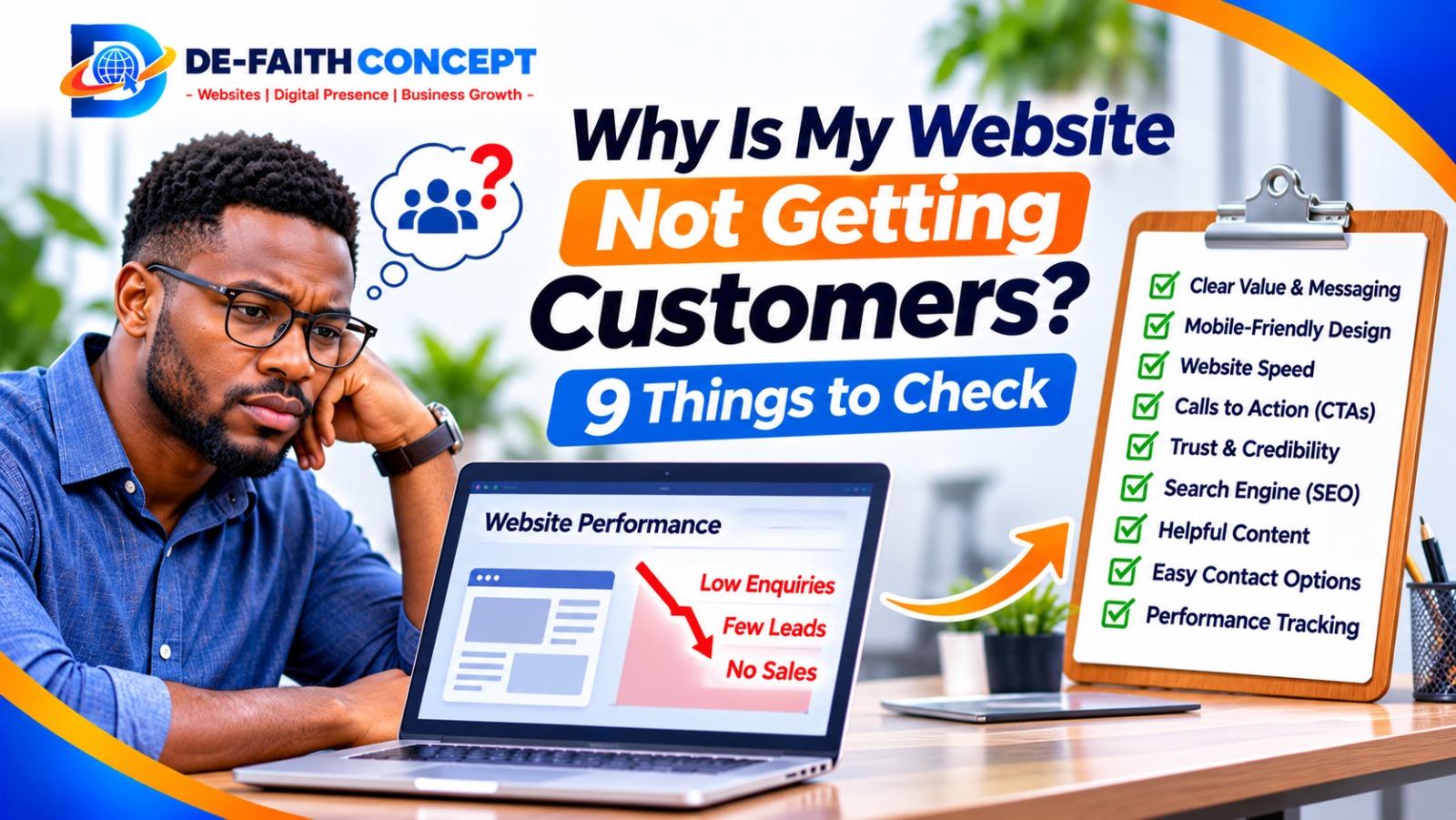
Having a business website is supposed to make it easier for potential customers to discover your business, learn about your services and contact you. But what happens when your website is online and still isn’t bringing in customers?
You may be receiving very few enquiries, getting visitors who leave without taking action, or struggling to turn website traffic into actual sales.
If this sounds familiar, you are not alone. Many businesses invest in websites but fail to get the results they expect.
The problem is not necessarily that your business has nothing valuable to offer. Your website may simply be making it difficult for visitors to understand your offer, trust your business or take the next step.
So, why is your website not getting customers?
In this guide, we explore nine common website problems that can affect enquiries and sales, how to identify them and what you can do to improve your website.
1. Your Website Does Not Clearly Explain What Your Business Offers
Imagine someone visiting your website for the first time. Within a few seconds, can they understand what your business does, who you serve and how you can help them?
If the answer is no, you may be losing potential customers.
Some business websites use vague headlines, complicated descriptions or generic statements that do not communicate the actual value of their services.
For example, a headline such as “Welcome to Our Website” tells visitors very little about what the business offers.
A clearer headline would be:
“Professional Website Design for Small Businesses That Want to Grow Online.”
This immediately communicates the service and the intended audience.
How to fix it
- Use a clear headline that explains what your business does.
- State who your products or services are intended for.
- Explain the main benefit customers receive.
- Use simple language that your target audience understands.
- Make your main services easy to find.
Your homepage should answer three important questions:
- What does your business offer?
- Who do you help?
- Why should someone choose your business?
Do not make visitors work hard to understand what you do.
2. Your Website Is Not Mobile-Friendly
Many potential customers browse business websites using smartphones. If your website is difficult to use on a mobile device, you could be losing enquiries before visitors even understand your offer.
Common mobile website problems include:
- Text that is too small to read.
- Images that do not fit the screen.
- Buttons that are difficult to tap.
- Menus that are confusing.
- Contact forms that are difficult to complete.
- Horizontal scrolling.
- Pages that load or display incorrectly.
A website that looks excellent on a desktop computer may provide a poor experience on a smartphone.
How to fix it
Make sure your website uses a responsive design that adapts to different screen sizes.
Check that:
- Text is readable without zooming.
- Buttons are easy to tap.
- Navigation menus work properly.
- Images fit the screen.
- Contact forms are simple to complete.
- Important information is visible without unnecessary scrolling.
You can also use Google’s PageSpeed Insights to assess your website’s performance and mobile-related issues.
A mobile-friendly website makes it easier for potential customers to interact with your business wherever they are.
3. Your Website Loads Too Slowly
Website speed can affect how visitors experience your business.
People may leave a website if its pages take too long to load, especially when they are browsing on mobile devices or using slower internet connections.
A slow website can also make it harder for visitors to explore your services, view products or complete enquiry forms.
Common causes of slow websites include:
- Large, uncompressed images.
- Poor-quality hosting.
- Too many unnecessary plugins.
- Excessive scripts and animations.
- Poorly optimised website themes.
- Unnecessary third-party integrations.
- Poor caching and performance configuration.
How to fix it
Start by checking your website using Google PageSpeed Insights.
Then consider the following improvements:
- Compress and optimise images.
- Use an appropriate hosting service.
- Remove unnecessary plugins and scripts.
- Enable suitable caching.
- Use a lightweight, well-optimised theme.
- Reduce unnecessary animations and visual effects.
- Review your website’s mobile performance.
Remember that website speed is not just a technical issue. It is part of the experience you provide to potential customers.
4. Your Website Does Not Have Clear Calls to Action
A visitor may like what they see on your website but still leave without contacting you because they do not know what to do next.
This often happens when a website lacks clear calls to action (CTAs).
A call to action tells visitors what step to take after viewing a page.
Examples include:
- Request a Quote.
- Book a Consultation.
- Contact Us.
- Shop Now.
- Get Started.
- Schedule an Appointment.
- Request a Free Website Audit.
Some websites hide their contact information at the bottom of the page or use buttons with vague labels.
This creates unnecessary friction for potential customers.
How to fix it
Place clear calls to action in important areas of your website.
Consider adding:
- A prominent button in the homepage hero section.
- Contact buttons on service pages.
- Enquiry forms where visitors learn about your services.
- A clear CTA at the end of blog posts.
- WhatsApp or phone contact options where appropriate.
Make sure each CTA leads to the correct destination and works properly on mobile devices.
Your website should guide visitors towards taking action rather than leaving them to figure everything out themselves.
5. Your Website Does Not Build Enough Trust
Before spending money, customers want to feel confident that they are dealing with a credible business.
If your website does not communicate trust, visitors may hesitate to contact you or make a purchase.
Trust-related problems can include:
- No clear business information.
- No testimonials or customer reviews.
- No examples of previous projects.
- Poor-quality images.
- Outdated contact information.
- Inconsistent branding.
- Spelling and grammatical errors.
- No clear explanation of how your business works.
A website does not need to look expensive to build trust. It needs to communicate professionalism, clarity and reliability.
How to fix it
Add relevant trust-building elements such as:
- A well-written About page.
- Genuine customer testimonials.
- Previous projects or case studies.
- Clear contact information.
- Professional business photography.
- Frequently asked questions.
- Clear service descriptions.
- Relevant certifications or professional affiliations, where applicable.
If you have completed projects for clients, showcase them.
People are more likely to consider your business when they can see evidence of the work you do.
6. Your Website Is Not Optimised for Search Engines
Your website may be professionally designed, but that does not automatically mean potential customers will find it through Google.
If your website is not properly optimised for search engines, you may miss opportunities to reach people actively searching for your products or services.
Common SEO problems include:
- Missing or poorly written page titles.
- Weak meta descriptions.
- Unclear website structure.
- Poorly organised headings.
- Pages targeting no specific search intent.
- Missing internal links.
- Unoptimised images.
- Little useful website content.
- Technical issues affecting search engine discovery.
For example, a website design company that only uses a homepage headline such as “Welcome to Our Company” may be missing an opportunity to communicate its services clearly to both visitors and search engines.
How to fix it
Start with the basics:
- Identify relevant keywords for your services.
- Give every important page a descriptive title.
- Write useful meta descriptions.
- Use clear H1, H2 and H3 headings.
- Create dedicated pages for important services.
- Add relevant internal links.
- Optimise images and their alt text.
- Publish useful articles that answer customer questions.
- Set up Google Search Console.
SEO is a long-term process. You should not expect every improvement to generate immediate enquiries, but a well-optimised website gives search engines and potential customers a better understanding of your business.
7. Your Website Content Does Not Address Customer Problems
Some business websites focus too much on describing the company and too little on explaining how they help customers.
Visitors are usually looking for solutions to their problems.
For example, someone searching for website design services may want to know:
- How much does a business website cost?
- Can I get a website for my small business?
- Will the website work on mobile devices?
- Can customers contact me through the website?
- Will my website be optimised for Google?
- Can I update the website myself?
If your website does not answer the questions your potential customers have, they may leave and look for a business that provides clearer information.
How to fix it
Create website content around your customers’ needs.
For example:
- Explain the problems your services solve.
- Describe the benefits of working with your business.
- Answer common questions.
- Provide useful information about your products or services.
- Explain your process.
- Address common customer concerns.
- Include relevant examples and case studies.
Your website should not simply tell people how good your business is. It should help them understand why your business may be the right solution.
8. Your Website Makes It Difficult for Visitors to Contact You
Imagine a potential customer is interested in your services but cannot easily find your phone number, email address or enquiry form.
That visitor may simply leave.
Some websites have contact pages that are difficult to find, forms that do not work or too many unnecessary fields.
Others provide only one contact option, even when their customers may prefer different ways of communicating.
How to fix it
Make contacting your business simple.
Consider including:
- A clearly visible Contact page.
- A working enquiry form.
- Your business email address.
- A clickable phone number.
- A WhatsApp contact option, if appropriate.
- Your business location or service area, where relevant.
- Clear response expectations.
Test your contact forms regularly to make sure enquiries are actually reaching your inbox.
If visitors cannot contact you easily, you may be losing potential business without realising it.
9. You Are Not Tracking Website Performance
One of the biggest mistakes business owners make is launching a website and never checking how it performs.
Without useful data, it becomes difficult to understand why your website is not generating customers.
For example:
- Are people visiting your website?
- Which pages receive the most traffic?
- Where are visitors coming from?
- Are visitors using mobile devices?
- Which pages do people leave quickly?
- Are visitors submitting your contact form?
- Which channels generate the most enquiries?
Without tracking, you may keep making changes based on assumptions rather than evidence.
How to fix it
Use suitable analytics and website monitoring tools.
Google Analytics 4 can help you understand website traffic and visitor interactions when configured correctly.
Google Search Console can help you monitor search visibility, search queries, clicks and indexing information.
You should also track important business actions such as:
- Contact form submissions.
- Phone calls generated by the website.
- WhatsApp enquiries.
- Consultation bookings.
- Online purchases.
- Quote requests.
Do not focus only on the number of visitors. Pay attention to whether the website is helping your business achieve its goals.
How to Know Whether Your Website Needs a Redesign or Just a Few Improvements
Not every website problem requires a complete redesign.
Sometimes, a few targeted improvements can make a meaningful difference.
For example, if your website looks professional but your contact form is not working, fixing the form may be more important than rebuilding the entire website.
However, a redesign may be worth considering if:
- Your website looks outdated.
- It is difficult to navigate.
- It does not work properly on mobile devices.
- Its structure no longer reflects your services.
- It is difficult to update.
- Its design does not represent your current brand.
- It has significant performance or usability problems.
Before deciding, assess the website’s design, content, performance, SEO, user experience and conversion process.
A professional website audit can help identify the problems that need attention and prioritise the most important improvements.
What Should You Do If Your Website Is Getting Visitors but No Customers?
If your website receives traffic but does not generate enquiries or sales, the problem may be related to conversion rather than visibility.
Start by reviewing the following:
- Does your homepage clearly explain what you offer?
- Are your services easy to understand?
- Are your prices or quotation process explained clearly, where appropriate?
- Are your calls to action visible?
- Does your website display genuine trust signals?
- Is the contact process simple?
- Does your content address customer questions?
- Does the website work well on mobile devices?
- Are your analytics and enquiry tracking configured correctly?
Look at the pages visitors actually use and identify where they may be encountering difficulties.
The goal is to make it easier for the right visitors to understand your offer and become customers.
Frequently Asked Questions
Why is my website getting traffic but no sales?
Your website may be attracting visitors who are not the right audience, or it may not be giving them enough reasons to take action. Review your content, calls to action, pricing information, trust signals and enquiry process.
Why is nobody contacting me through my website?
Possible reasons include unclear service information, hidden contact details, broken enquiry forms, weak calls to action or a lack of trust. Test your contact options and make it easier for visitors to reach you.
Can a poorly designed website affect sales?
Yes. Confusing navigation, poor mobile usability, slow loading pages and unclear information can make visitors less likely to engage with your business.
Does SEO help a website get customers?
SEO can help potential customers discover your business through relevant search results. However, traffic alone does not guarantee sales. Your website must also provide useful information, build trust and make it easy for visitors to take action.
Should I redesign my website if it is not generating leads?
Not necessarily. First identify the actual problems. Some websites only need improvements to their content, contact forms, calls to action or performance. A complete redesign may be appropriate when the underlying design or structure is no longer suitable.
How can I check if my website is working properly?
Test it on different devices, check your contact forms, review website speed, inspect important links and monitor traffic and enquiries using suitable analytics tools.
Final Thoughts: Your Website Should Do More Than Just Exist
Having a website is a good start, but simply being online is not enough.
Your website should help potential customers understand your business, discover your services, trust your brand and take the next step.
If your website is not generating customers, do not immediately assume that you need to spend money rebuilding everything. Start by identifying the problems and understanding what may be preventing visitors from becoming enquiries or sales.
Sometimes, improving your content, mobile experience, website speed, calls to action or contact process can make a meaningful difference.
However, if your website has deeper design, technical or structural problems, professional help may be the right next step.
Is Your Website Struggling to Generate Customers?
At De-Faith Concept, we help businesses build, improve and optimise their websites to create a stronger online presence.
Whether you need a website audit, redesign, performance improvements or a professional business website, we can help you identify a suitable solution.
Explore our website design services or view our previous projects.
You can also request a free website audit to get a better understanding of areas that may need attention.
Ready to improve your website?
Contact De-Faith Concept to discuss your website and business goals.